

Is a Kaftan Moroccan or Algerian? The Honest Answer
Heritage HandmadeCompartir
Both countries wear kaftans, and the garment itself is much older than either of them. Historians trace the kaftan to Persia and the Ottoman world, and it spread across the Middle East and North Africa from there. What people usually mean by the question is which country made its own version famous. The Moroccan kaftan, with its hand embroidery and two-piece takchita, was added to UNESCO's heritage list in 2025.
Here is the longer story, in the order people usually ask.
Where does the kaftan come from?
The kaftan is an ancient robe. FIT's fashion history notes say it originated in ancient Persia and spread across Central and Western Asia. The Metropolitan Museum of Art, quoted there, says the type of garment called a kaftan was known in Persia and the Ottoman Empire before it arrived in Morocco, probably in the 16th century. Other Moroccan sources trace it back to the medieval period, through the Andalusians who settled in North Africa. Historians do not agree on the exact date, but they agree it came from the East.
The word follows the same path. It comes from Persian khaftan and appears in Arabic as qaftan and in Turkish as kaftan.
So why do people say it is Moroccan?
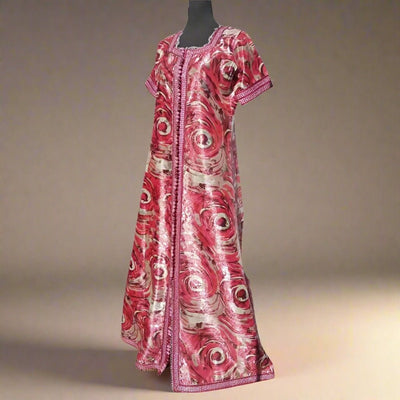
Because Moroccan artisans made it their own. Over the centuries they developed styles and skills you can recognize on sight: hand embroidery, hand-stitched sfifa trim, knotted buttons, and the two-piece takchita for weddings.
In December 2025, UNESCO inscribed "Moroccan Caftan: art, traditions and skills" on its Representative List of the Intangible Cultural Heritage of Humanity. UNESCO describes the caftan as a long tunic worn by people of all genders and ages for special occasions and celebrations. Note what this recognition covers: the Moroccan caftan's art, traditions and skills. It does not say that no other country has a kaftan.
Does Algeria have kaftans too?
Yes. Algeria has its own traditional dress and its own kaftan styles, worn at weddings and celebrations, and Algerians are proud of them, just as Moroccans are proud of theirs. Neighboring countries sharing a garment is normal: clothing travels with people, trade and marriage. We are a Moroccan workshop, so we speak for the Moroccan tradition we make every day in Marrakech.
How can I tell a Moroccan kaftan from other kaftans?
There is no single rule, but these details point to Moroccan craftsmanship:
- Embroidery and trim made by hand, such as sfifa braiding
- Hand-knotted buttons down the front
- Silk, velvet or brocade, finished with care inside as well as outside
- A matching belt (a mdamma), and for weddings the two-piece takchita
Want the details? Read takchita vs kaftan: what is the difference, or browse real examples in our Moroccan kaftan dresses.
Is it kaftan or caftan?
Both are correct. They are two spellings of the same long robe, and you will see both on shop pages and in books.
Where can I see old Moroccan kaftans?
Our vintage Moroccan kaftan collection has one-of-a-kind pieces from the 1960s to the 1990s, with hand embroidery and brocade that is rarely made today.
Frequently asked questions
Who invented the kaftan?
No single person or country. It began in ancient Persia and spread across Asia, the Middle East and North Africa.
When did the kaftan reach Morocco?
Sources differ: the Met says probably the 16th century, while Moroccan sources point to the medieval period.
Is the Moroccan caftan on UNESCO's list?
Yes. It was inscribed on the Representative List of the Intangible Cultural Heritage of Humanity in 2025.
What is a takchita?
A two-piece Moroccan gown: a plain inner dress under an open, embroidered overdress, closed with a belt.
Are your kaftans made in Morocco?
Yes. Each kaftan is cut, embroidered and finished by hand in Marrakech.
Sources: FIT: The Kaftan, UNESCO: Moroccan Caftan, art, traditions and skills, UNESCO decision 20.COM 7.B.33.


